


With more and more electronic doodads on our bikes, it’s not a matter of “if” you’ll ever experience a dead battery on the road, but “when” you will. It’s going to happen, but with proper planning and some pro tips on your side, the impact of a dead battery can turn from catastrophic to a minor inconvenience.
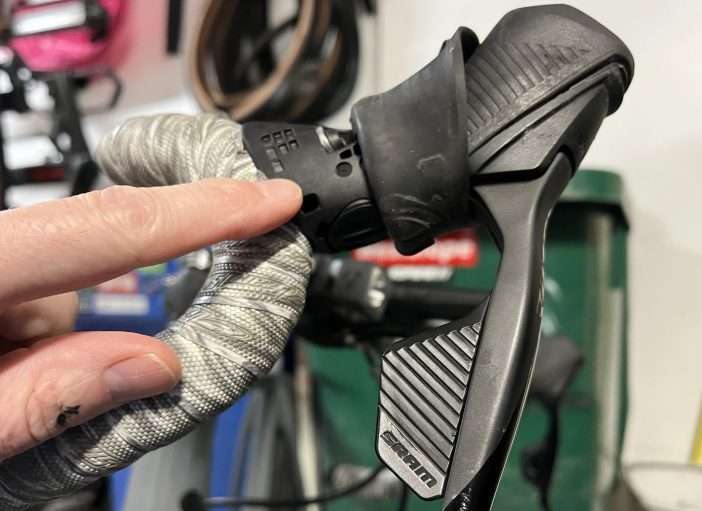
First, let’s flashback two months when I replaced the CR2032 coin cell battery inside the my left SRAM Rival AXS shifter. Yes, I just replaced one side because the right lever still had some juice left. And, I wanted to see what would happen. The process for changing this battery was simple: roll back the rubber hood cover, open the battery cover, replace the battery and roll the hood cover back in place. SRAM has a great video for this and you can easily check your battery life based on the following diagram.

With the left battery replaced, I continued riding for a few months until I noticed some degradation. The shifter would sometimes require a few taps to start responding if it wasn’t used for a few minutes. But, like most of us, I got home and racked up the bike — forgetting about it until the next ride. Well, eventually, that caught up with me and today it died completely in the middle of a ride. So, what did I do when my AXS shifter battery died? I switched to manual mode.
Manual shifting with SRAM AXS
As I explained in the video, it’s obviously not ideal, but I continued on my ride and just conserved gears between manual shifts. The process is the same whether you lose right or left shifting. It’s a process of shifting all the way up or all the way down the cassette to allow the opposite lever to continue working.
Since my right shifter was dead, I would shift into the highest gear using the AXS button, then continue using my left shifter as needed to change to a lower gear. My shifting threshold changed because I wanted to avoid dismounting as much as possible. As a result, I climbed some hills like I was riding a single speed. If the left shifter was toast, I would do the opposite.
How to manually shift SRAM AXS derailleurs:
- Single-tap the AXS button to go down the cassette (higher gear)
- Double-tap the AXS button to go up the cassette (lower gear)
Keep this process in mind should your shifter battery die mid-ride or if you’re working on your bike in the stand. And, once you replace the battery, you’ll likely have to re-pair your shifters. Don’t worry… that’s also an easy process that’s explained in this video.

So… if your shifter battery dies mid-ride?
Take a deep breath and think through your remaining route — carefully metering out any shifts as needed. And, when you need to reload the cassette, just dismount and manually shift to the top or bottom using the AXS button on the rear derailleur. Oh, and even if one battery still has life, it’s probably wise to just change both batteries. Lesson learned.

8 Comments
I have seen these shifter and derailleur sets fail to pair after 2032 battery replacements . What then ?
Perhaps I don’t understand axs shifting compared to normal shifting: where left lever is FD and right lever is RD. In my mind if axs worked (or could be set to work) like traditional shifting and 1 lever battery dies, just make sure the the lever with the working battery (sounds like swapping battery between levers isn’t too hard) is the one working the RD (and keep FD on small chain ring)
Just carry a couple of spare cr2032’s it takes about 90seconds to replace them and everything uses those batteries so spares should be part of every kit. If one of your mech batteries dies swap them around … it’ll get you home or to the finish line.
Generally AXS Is incredibly reliable even shifting reliable underwater on couple of events where section got flooded !
I had that same issue until I fully went through the full pairing process. Here’s what I did:
1) Press and hold AXS button on the rear derailleur to go into paring mode (blinking)
2) Press and hold the AXS button on the right shifter until the derailleur blinks
3) Repeat #2 with the left shifter
4) Press and hold the rear derailleur AXS button again to confirm
I kept only pairing the new shifter by just pairing that one. But, I found that I had to re-pair both during that sequence. Once I figured that out, it was a breeze, but a little baffling until then.
Better to go to Sram app and switch the controls for your working shifter. And you can as well do derailleur manually by button while riding. This way you can continue riding without dismounting
Definitely another option, but you’ll still only be able to shift one direction on the cassette since you will only have a single active shifter (unless you have blips). And, you’ll still need to get off the bike and activate the AXS button on the rear derailleur to enter the configuration mode. I only see that as valuable should you wish to have the shifter change to shift up or down the cassette.
Garry: With AXS, there’s just one button on each shifter, not two. You can’t configure one shifter to shift both up or down the cassette, for example.
Absolutely. Keeping spared on-hand is wise on long races for sure. However, in my case, the dead battery was part system test and part neglect. I kind of wanted to see what would happen and how I would cope with it on the road.
At the end of the day, it’s best to swap those shifter batteries out every year (or sooner), based on the above battery chart. SRAM AXS is an incredible ecosystem and I love the built-in tricks to get you home in a pinch.