


When the previous SRAM Force AXS groupset was released, some were mixed on the visual design, but it otherwise performed just as expected. In the past four years, I’ve tested it in various combinations on both road and gravel bikes with much success. If it wasn’t broken, why did SRAM revamp their latest Goldilocks groupset for 2023? The answer is they wanted to further solidify Force AXS as the people’s groupset with a few key improvements. And maybe, just maybe open the door for a clear path to a major update to SRAM Red AXS in 2024? Hmmm.
SRAM Force AXS Groupset Features (2023 Update):
- Updated color scheme for a more premium look
- Fully wireless 12-speed design using SRAM AXS batteries
- Updated hood shape mimics Rival AXS
- Carbon-bladed levers
- Reach adjustment for brake/shift levers
- Carbon fiber crankset arms
- One-piece 2x chainrings with power meter option
- Single-sided power meter option
- 1x AXS XPLR or mullet capability
- Road and gravel gearing
- Compatible with Wireless Blips for remote shifting capability
- Standard rear derailleur fits cassettes up to 36t
- Weight: ~2922 grams (2x complete)
- MSRP: $2640 as tested (integrated, dual-sided power meter)

The people’s groupset?
Hot on the heels of my review of the venerable Shimano Ultegra R8100 Di2 groupset, I’m digging into the latest update of SRAM’s everyman groupset — Force AXS. As tested, I have had the 2x power-equipped groupset that now has the appearance of the best of Red and Rival AXS kits in a sleeker and sexier design. I know it’s aesthetic, but I do really like the sparkly black/silver look of the new Force AXS, but the updates and performance go beyond that.
Once again, the SRAM AXS ecosystem is a breeze to set up and maintain. The AXS App makes quick work of firmware updates or configuration. And, without wires to fish through the frame, your mechanic will revel in one less thing to cuss out when dealing with full internal cable routing.

Set up aboard the Fezzari Veyo SL aero road bike, I’ve had mid-range 48/35T chainrings matched with the 10-33t cassette for a not-quite 1:1 low-end. With this gear ratio, I still have the low-end needed on even the steepest local climbs, but now have a little more on the upper-end to match the needs of a modern aero road bike. In fact, with the 48/10 gearing, I can still pedal up to about 40-41 mph, which is about as fast as I typically descend. Most of my recent gearing has been lower, so it was nice not to top out so early.
Without that 1:1 gear, I had a little more traditional gearing for climbs and I felt a little slower as a result (but maybe I’m just getting old?). But, my fastest times ascending the 11-mile, 3000 ft. American Fork Alpine Loop climb are all on what I would call “traditional gearing.” That being said, the 35/33 combo was always sufficient — even on 10-12% pitches. In addition, the 10-33t cassette does offer a little tighter jumps to maintain just the right speeds and cadence on climbs or rolling flats.
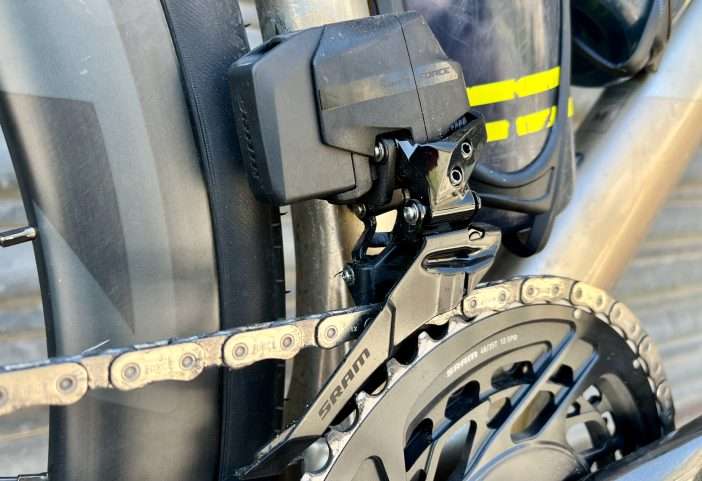
I’ve already had trouble discerning much difference between Shimano Di2 and SRAM AXS shifting speed or quality and this latest iteration makes that differentiation even more difficult. I will say that Di2 does take a slight lead on rear derailleur shifting and both are about the same up front. Honestly though, it’s so minimal that only someone who has ridden both back-to-back will be able to tell the difference. After some careful inspection, you’ll notice that the most recent Force cassettes do have a rubber insert just ahead of the largest cog to further quiet the cassette while shifting. I feel like it works and shifting has been somewhat quieter now.
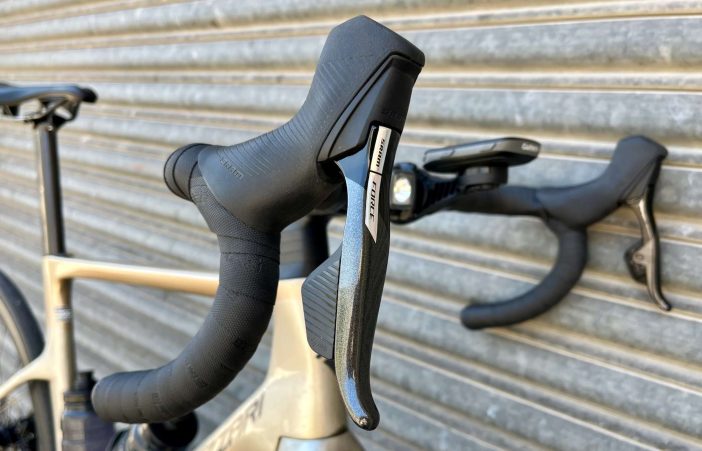
eTap paddle shifting FTW
While Shimano insists their shift buttons are optimized for racing, it’s hard to argue that SRAM’s aren’t race-optimized also. Shimano’s choice to have small shift buttons does reduce all-weather ergonomics since it’s difficult to hit those buttons when wearing full-finger winter gloves. I’ve said for years, along with every other reviewer, that eTap’s shifting process is DROP DEAD SIMPLE. A single paddle on each lever that functions like paddle shifting in a car remains the gold standard in my opinion. No complaints from me on the function or performance of the new SRAM Force AXS. And, I can shift reliably with winter gloves on.
I have to mention one of my favorite features of SRAM AXS and it’s the easy ability to micro-trim the rear derailleur while on the bike. I am constantly swapping wheelsets and I changed between four different wheelsets (Zipp 353 NSW, Zipp 303 S, Elitewheels Drive G45 and Bontrager Aeolus PRO 37V) during the 6+ month test period. Going from the 353 NSW to the Drive G45’s, I forgot to fine-tune the shifting and when I got to my first real climb, shifts were terrible. The beauty of SRAM AXS is all I had to do was activate the AXS button on the shifter and micro-trim it to perfection. A few hundred feet and a couple of adjustments and I was back in business — all without even getting off the bike.
Honestly, the best way to trim out your shifting is in the saddle, under load and only SRAM AXS allows you to do that easily.

Bring on the ka-power
The new Force AXS crankset now looks like Darth Vader customized the shiny RED AXS chainrings. In fact, that black treatment throughout speaks to me — I really like it. Aside from the black color scheme, the one-piece double chainring and dual-sided Quarq DZero power meter combo provides accurate power measurements to optimize output and analysis. A one-piece design also saves weight and the material is said to last 50% longer than SRAM’s 11-speed chainrings. I’m still trying to find out if they will do a half-price replacement if you are one of the few to wear them out.
As with all AXS components, there are a myriad of batteries and they to seem to drain a little faster than I would like. It’s helpful to have a couple of charged batteries on-hand at all times. A quick pre-ride battery check is always a good idea and replacement is a breeze. No, they don’t last as long as Shimano Di2, but it’s easy to change and I love that I can drop a charged battery in a pocket on a long ride for peace of mind.

Those smaller hoods
The smaller hoods, mimic the Rival AXS designs and eliminate wired ports. I didn’t ever feel like SRAM RED or the prior-generation Force hoods were too large, but they are notably larger than Shimano Dura-Ace and Ultegra. Now, this smaller design is pretty close to Shimano and it’s one of those things I didn’t know I would appreciate until I tried it. Now I do prefer the smaller hood shape and love how it feels when pushing hard on the flats or standing and sprinting or climbing. It is much easier to dance around them and access the perfectly-shaped brake levers.
Braking power and modulation are outstanding from either the hoods or drops and the carbon-blade levers don’t get freezing cold like alloy ones will. With all the wheelset changes, I also used a variety of rotors and all of them performed quietly and confidently. From the drops, one or two-finger braking is a breeze. From the hoods, a single-finger brake pull often gets blocked by the remaining fingers hitting the shift paddle, so I often just two-finger braked from the hoods. The lever’s pivot point is such that it’s easy to pull from either location. I also noticed that the return speed on the left brake lever felt occasionally slower than the right lever. It’s possibly due to a less-than-ideal bleed on install. I’ll post updates as this groupset migrates to another bike build in the spring.

Why RED (or Rival)?
Good question. After riding SRAM RED AXS for thousands of miles and now the latest SRAM Force AXS, the only reason you should demand RED is if you want the lightest bike possible. Titanium and carbon bits add up to a significant weight savings, but at a serious cost. Going down to Rival AXS is also a compelling option, but the carbon cranks, brake levers and the option of a dual-sided power meter will tug at the racer inside. I see the new Force AXS as an honest RED replacement at this point (for those without bottomless pockets) — until a new RED groupset is introduced. And, on the other end, a full Rival AXS kit will save considerable money over Force AXS and yield the same performance with a minor weight penalty and the minor issue of a single-sided power meter. Still, Force remains the people’s groupset with the best of Red while still remaining affordability — especially with OEM builds, like the one on the Ari Suncrest.
Buy Now: Available from CompetitiveCyclist.com
The Bottom Line
SRAM's timely updates to their still-racy Force AXS groupset have both improved the looks and ergonomics of their second-tier kit. Of course, the eTap shifting is top-notch and the overall shifting performance is on par with what I've come to expect from SRAM AXS. Braking is also solid and the smaller hoods feel a little better in-hand than the previous-generation.
The Good:
- eTap shifting remains smooth and intuitive
- Clutch eliminates chain slap on even the roughest terrain
- Smaller hoods feel nice in-hand
- Dual-sided power meter makes it easy to measure your efforts
- SRAM AXS App is easy to use/customize
- Rear derailleur adjustments are a breeze in-the-saddle
- Available in road or gravel options
- The black color looks sleek, IMO
The Bad:
- Unified power meter and chainrings still causes a stir
- Bulky front derailleur can reduce tire clearance
- Double-check the battery status before every ride -- they drain faster than you think
- Shift Quality
- Braking
- Ergonomics
- Setup and Adjustability
- Overall Value
