


I love running. I love music. I usually don’t like the two of them together. I’m definitely kind of a ‘back to nature guy,’ and if I’m out on a trail run I want to hear the birds or the wind in the trees. But, let’s be honest, nobody likes a puritan and even I will pop on some tunes on a long run or if I’m in a big training ramp up. The solution? Obviously a nice open-to-the-world option like the Suunto Spark, which I’ve been testing on runs, hikes and bikes throughout my summer.
Suunto Spark Headphones Features:
- Open-ear design helps you stay aware of your surroundings
- 9.7g per earbud for a lightweight, barely-there feel
- Up to 7 hours of battery life, or 36 hours with the charging case
- IP55 weather resistance for sweat, rain, and dusty adventures
- Environmental noise cancellation for clearer calls and voice capture
- Bluetooth 5.4 with dual-device connectivity
- Head-gesture controls for hands-free interaction
- Running metronome with adjustable cadence cues
- Real-time running metrics through compatible Suunto watches
- Voice training feedback for pace, heart rate, distance, and lap data
- Suunto App integration for customization, updates, and training features
- USB-C charging for the carrying case
- MSRP: $179

Welcome to the Suunto family’s newest addition:
It’s a great time to be a runner. Whether trail or road, the sport is enjoying a ton of attention and in my opinion the gear is in an absolute golden age. The ‘barely there’ shoes, shorts, shirts and hydration solutions that you can buy right now can help you grind out the miles without thinking twice about your gear. I think the Suunto Sparks fit neatly into this zeitgeist: a high performance piece of audio tech that you can kind of forget about while you’re wearing it.
The Sparks are built from a silicone outer which surrounds a ‘memory titanium’ alloy loop which hugs your ear. This is an open back design, so it uses air conduction just like an old fashioned headphone. This is the big differentiation point when you’re deciding on a pair of running headphones since you have to choose between air and bone conduction.
I’m a bit of an audio guy, I play piano and guitar and have a few pairs of nice headphones that I use when I’m at my desk. For me, the draw to air conduction is obvious because the sound quality is just inherently superior for human ears. If you’re shopping for a killer whale, different story. I’m very pleased with the audio quality of the Sparks, and I don’t feel like the open back design sacrifices anything; in fact many nicer studio headphones have an open back design to give a more spacious sound. This is really subjective, but I think only true sound snobs will find anything to quibble about in this running-specific piece of kit.
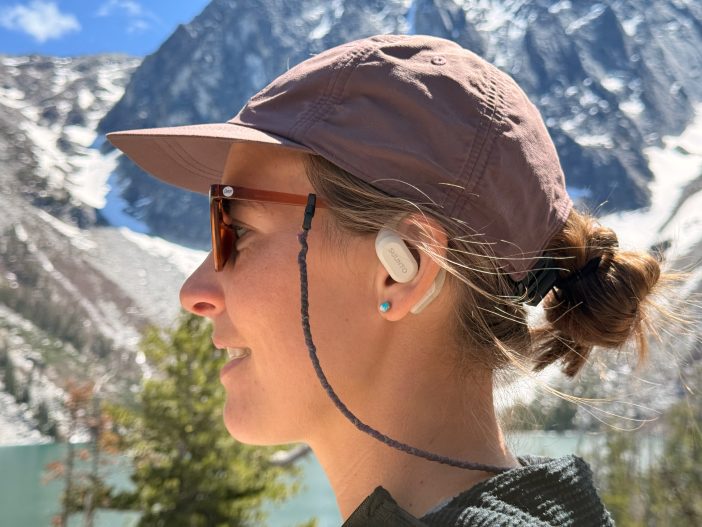
The trouble with air conduction is that there’s going to be something sitting in from of the ol’ ear hole, and that’s the case with the Suunto Sparks. I really wondered if this was going to bother me (aka keep me from hearing the birdsong while I was running), and, in fact, it does not. Suunto has done a really nice job designing a minimally intrusive air conduction headphone that sits over your ear but preserves 90% of your environmental awareness.
The headphones themselves are deliciously light, at just 9.7g each. That’s really light. The case is heavier at 60g but still easy to throw in a pack (but, at least for me, too big to comfortably put in a shorts’ waistband). Between the case and the headphones, you can get 36 hours of listening before charging. I must say, I never worried about battery life.

The Sparks integrate perfectly into Suunto’s running app, so if you’re already wearing their watches or other devices this will be a part of your ecosystem. Suunto integrated some great running-specific features, most noticeably audio cues for cadence and a ‘sport track mode’. This mode tracks your cadence, ground contact and vertical oscillation in real time so you can get feedback on your form and running efficiency. The metronome audio cues range from 120-200 bpm and can play over your music, or alone.

The app is where you also access most of the Spark’s features and customization. There’s a fully adjustable EQ interface in addition to presets for common preferences. I personally love the ‘find my headphones’ feature because I misplace things in the house all the time. This can help you locate the headphones together or individually, but not the case.
The one area where the Spark is a little troubled is with the on-device controls, specifically gesture controls and touch controls. You can add a ton of customization to the ‘tap’ function on the side of the headphone, cueing up five different commands based on your sequence of taps. Similarly, nodding or shaking your head can be mapped to sound and call controls. In my testing, the execution just wasn’t good enough to make me want to use this feature. The sensitivity was too high, and my most common complaint was the Sparks skipping a track right during the good part.

In use, the Sparks are really a delight. They’re so light and unobtrusive, and they played well with a variety of cycling and running glasses as well as my gravel and MTB helmets. They don’t jiggle too much when I run, and the lack of seal (compared to my AirPods Pro) meant there was no distracting noise from the ear/earphone interface. I loved these for running, and I also tossed them on for some grindier climbs on my mountain bike.
Buy Now: Suunto Amazon Store
The Bottom Line
The Suunto Sparks have won me over. I went into this review skeptical that I’d want anything between me and the sounds of the trail, but these are so light and unobtrusive that I mostly forgot they were there. Sound quality is excellent for an open-ear headphone, environmental awareness remains impressive, and the running-specific features are genuinely useful. The gesture controls need some work, but that’s a relatively minor complaint. For runners who want music without completely checking out of their surroundings, the Sparks are an excellent option.
The Good:
- Exceptionally lightweight at just 9.7g per earbud
- Excellent environmental awareness without sacrificing much sound quality
- Secure, comfortable fit that plays nicely with glasses, hats, and helmets
- Excellent battery life with 36 hours of total listening time including case charges
- Useful running-specific features, including cadence cues and real-time running metrics
The Bad:
- Gesture and touch controls are overly sensitive and subtract rather than add
- Charging case is a little bulky for carrying in a running shorts waistband
- Not cheap!
- Sound quality
- Durability/weatherproofing
- Battery life
- Lightweight
- App/integrations
- Lack of jiggling
